On this page
Mushroom Growing Guides
How to grow mushrooms at home
Every grow kit we make ships with a printed instruction card, but most people would rather read the whole process before they open the bag. This is the complete version: what actually happens inside a block, what it looks like at every stage, and what to do when something goes sideways.
The four variables that decide your harvest
Strip away the equipment and every mushroom grow comes down to the same four inputs. Get these right and the fungus does the rest. Get them wrong and you will spend a month watching a block do nothing.
1. Temperature
Most species fruit between 55 and 70°F. Lion's Mane prefers the cool end of that range and will fruit faster in a cellar than on a warm kitchen counter. Pink Oyster is more forgiving and will push past 75°F, which is why it is our outdoor block.
The single most common mistake is putting a block somewhere that swings between 50°F at night and 80°F in the afternoon. Fruiting is triggered by a stable temperature, not a high one.
2. Humidity
Aim for 80-95% relative humidity. This is higher than most people assume, and it is the reason so many first attempts fail. A clear plastic bag with a handful of air holes over the block is genuinely enough for a beginner. The goal is a sealed, humid pocket, not a sealed, airless one.
You can tell humidity is right by looking at the block: the surface should look slightly damp and glossy. If it looks bone dry and pale, it needs more humidity. If it is visibly wet and dripping, it needs more air.
3. Fresh air
Mushrooms need oxygen, and the same bag that holds the humidity can hold the air out. If you see long, thin, pale stems or fuzzy grey caps on the underside of the cap, your block is suffocating rather than fruiting.
Open the bag once a day for ten minutes. That is genuinely all it takes. Many growers also fan the bag out and away from the block a few times during that opening, which helps the new pins dry off and reduces the risk of bacterial spotting.
4. Light
Indirect daylight is plenty. Mushrooms are not photosynthetic, so they do not need light to feed, but they do need a normal day-and-night cycle to trigger fruiting. A shelf in a room with a window is ideal. Direct sun is not - it overheats the block and dries it out too quickly.
Day-by-day: what a block is doing
Our blocks ship fully colonised, which means you skip the white, web-like growth phase entirely. Here is what the first month actually looks like.
Days 0-3: The break
The moment you unwrap the block, oxygen reaches the mycelium and it starts to fruit. You may see a faint misty haze of tiny white pins within 48 hours, especially on a warm block. This is not mould - mould is fuzzy and discoloured, while pins are distinct, smooth and rounded.
Days 3-7: Primordia
The pins swell into small bumps that look like tiny cauliflower florets. This is the stage where most growers panic and assume something is wrong. It is the best possible sign. Resist the urge to help them along; just keep the humidity up.
Days 7-14: The fast flush
Between days seven and fourteen the cluster expands quickly. Stems stretch, caps flatten out and start to colour. Pink Oyster develops its salmon-pink blush from the centre outwards. This is the stage you will want photographs of, because it happens fast.
Days 14-21: Harvest window
Harvest when the cap edges are still slightly rounded and the underside is just starting to show gills. If you wait until the caps are flat and brittle you will lose the best texture - and the yield.
Days 21-35: The second flush
Cut the cluster at the base rather than pulling it, which tears the substrate and risks contamination. After a couple of days, water the block again and it will give a smaller second flush. Most blocks are finished after two.
Troubleshooting: what you are seeing
Nothing at all after two weeks
Almost always humidity. The block should be visibly damp. If it is dry, the answer is a bag, a bin, or a damp towel draped over the top. If it is already damp, check the temperature - it is probably too cold or swinging too much.
White cottony growth
This is mould, not mycelium, and it usually means the block has been sitting in a wet, airless pocket. Remove the affected section with a clean knife if it is localised, and improve air exchange immediately. Prevention is always better than cure here.
Long thin stems with small caps
This is a classic symptom of insufficient fresh air, often combined with too little light. Open the bag daily and move the block a little closer to a window.
Tiny caps, grey and fuzzy
Botrytis, a common mould that thrives in still, humid, unventilated conditions. Remove it and increase airflow. Do not eat it.
Yellow weeping or wet patches
Usually bacterial. It is not dangerous, but it will shorten the life of the block. Improve airflow and keep the surface from staying saturated.
Question one
Answer one.
Complete the grow
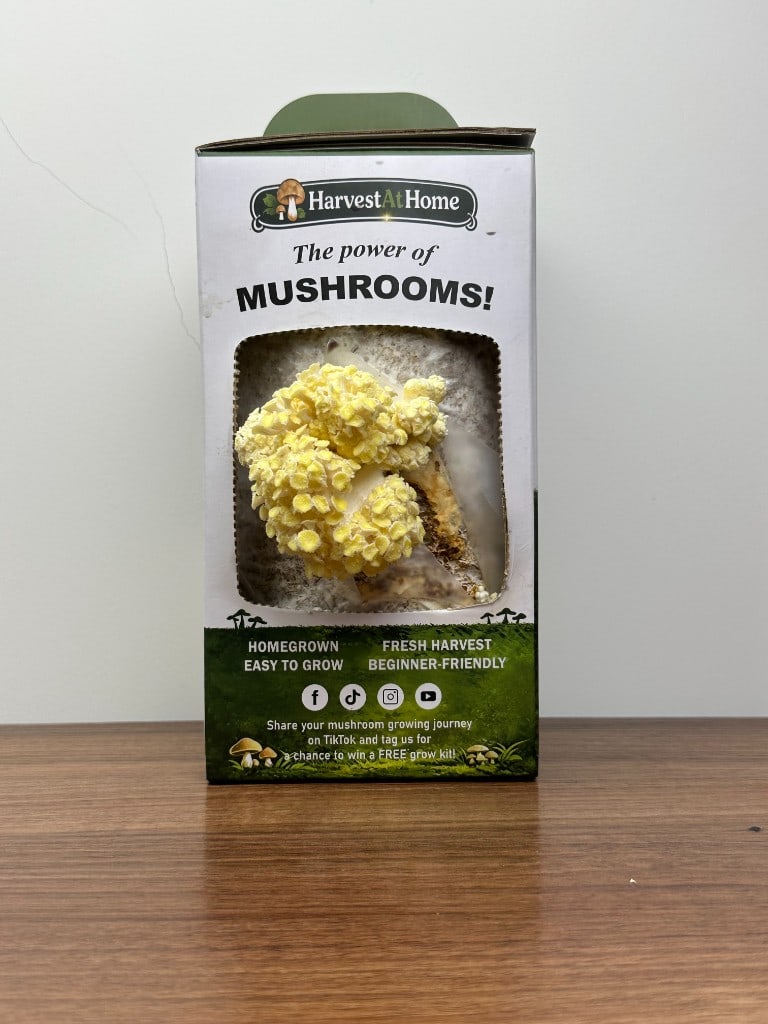
Pink Oyster 'Plant & Grow' Mushroom Block
Outdoor-ready.