On this page
Sustainability
A crop that needs no farmland and no irrigation
Mushrooms are an unusual food crop. They do not need soil, they do not need water delivered on a schedule, they do not need sunlight, and they grow vertically in a controlled space. That means they can be grown in places that are not arable at all, using water that is not fit for agriculture.
But the most interesting thing about mushrooms is not how they grow. It is what they grow on.
The waste problem
Every year, the agricultural sector produces enormous volumes of by-products. Softwood and hardwood sawdust from sawmills. Wheat straw from grain harvests. Both are dry, fibrous, and rich in carbon - which makes them ideal food for fungi, and useless for most other purposes.
Historically, most of this material went to landfill, was burned, or was used as low-value animal bedding. Growing mushrooms on it converts a waste stream into high-value protein while the spent substrate comes back out as a soil amendment.
Our feedstock
Hardwood sawdust
Sourced from regional sawmills within a few hundred miles of our facility. We specify hardwood species - oak, maple, beech - because lignin-rich hardwoods break down more slowly and give the substrate structure that holds water without collapsing. We do not use softwood, which is resinous and inhibits fungal growth.
We do not use treated or reclaimed lumber. There is no way to verify what a reclaimed sawdust stream has been through, and it is not worth the risk.
Wheat straw
Sourced from food-grade grain farms. Straw adds nitrogen and gives the substrate its open, airy structure, which is what lets fresh air reach the mycelium deep inside the block. Too much and the block compacts and goes anaerobic; too little and it dries out.
Our blend is roughly two parts hardwood sawdust to one part wheat straw by volume, and it is the same blend we have used since the first batch in the garage.
What we do not do
No virgin material
We do not buy peat, coco coir, or clean hardwood chips. Every gram of substrate we use is a byproduct of another industry. This is a deliberate constraint: it is harder, it is more expensive per kilo, and it makes the supply chain seasonal. We would rather have the constraint than have a product that quietly depends on resources someone else has to extract.
No pesticides or fungicides
Not on the substrate, not in the fruiting rooms. We manage contamination by pasteurisation, quarantine and inspection, not by suppressing other organisms chemically. This is partly an environmental decision and partly a commercial one - it means we cannot hide a contamination problem behind a spray, so we have to actually solve it.
Packaging
The carton
A printed corrugated board carton on FSC-certified stock with water-based inks. It is designed to be flat-packed for shipping but is sturdy enough to be reused - it makes a good gift box, a storage box for tools, or a seedling tray.
The mycelium bag
Breathable, with a filter patch that lets gas exchange happen without opening. It is not plastic-free - it is a lightweight polythene film - but it is a small fraction of the total packaging weight, and we are working on a compostable film that will break down in a home compost within 180 days.
No plastic void fill
We do not use bubble wrap, packing peanuts or plastic air pillows. Blocks ship in a snug cardboard fitment that needs no void fill at all, which removes the single most common source of plastic packaging in the e-commerce shipping box.
Shipping
Blocks ship Monday to Wednesday so nothing sits in a depot over a weekend, and we ship in regional batches to keep delivery times short. We do not air-freight anything.
We are not carbon-neutral, and we are not going to claim we are. Buying offsets to make a number look good is not the same as reducing emissions. What we have done is reduce the emissions we can measure: shorter shipping distances, no air freight, no plastic void fill, and packaging that is mostly paper.
The numbers
We publish these because a claim without a number is a slogan.
97% of substrate by weight is agricultural byproduct
The remaining 3% is the wheat bran and gypsum we add for nutrition and structure. This has been true since our first batch.
Zero plastic void fill in every shipment
Since we moved to a fitted cardboard shipper in our second year.
100% of spent blocks are compostable
Our substrate contains no plastic, no wax and no persistent chemicals. A spent block can go straight into a garden bed or a compost pile.
1 block = 250-350g of fresh mushrooms
That is the honest comparison. Growing the same weight of protein from a crop like chicken or beef uses roughly 8-15 times the land and a vastly greater volume of water.
What we are still working on
A compostable bag film
In testing. The current film breaks down in industrial composting but takes considerably longer than we would like in a home compost.
Returning spent blocks to growers
We are piloting a mail-back scheme for spent blocks, so they are collected and processed into a soil amendment rather than being landfilled by the customer. We would rather close the loop ourselves.
Publishing our facility's energy use
We control temperature and humidity in the fruiting rooms, which is where almost all of our energy goes. We are not yet comfortable publishing the number, because it is high and we would rather fix it than explain it. We will publish it when it is good enough to be worth reading.
Why this matters more than it sounds
Most of the food on a plate in a Western city comes from a supply chain that is optimised for cheapness rather than for what happens upstream. Growing a crop on a waste stream, in a building that is not farmland, without irrigation or pesticides, is a small example of a different approach.
It is not a solution to anything on its own. But it is a real, repeatable, small-scale demonstration that the same principle scales - and it makes a very good dinner while it does it.
Question one
Answer one.
Complete the grow
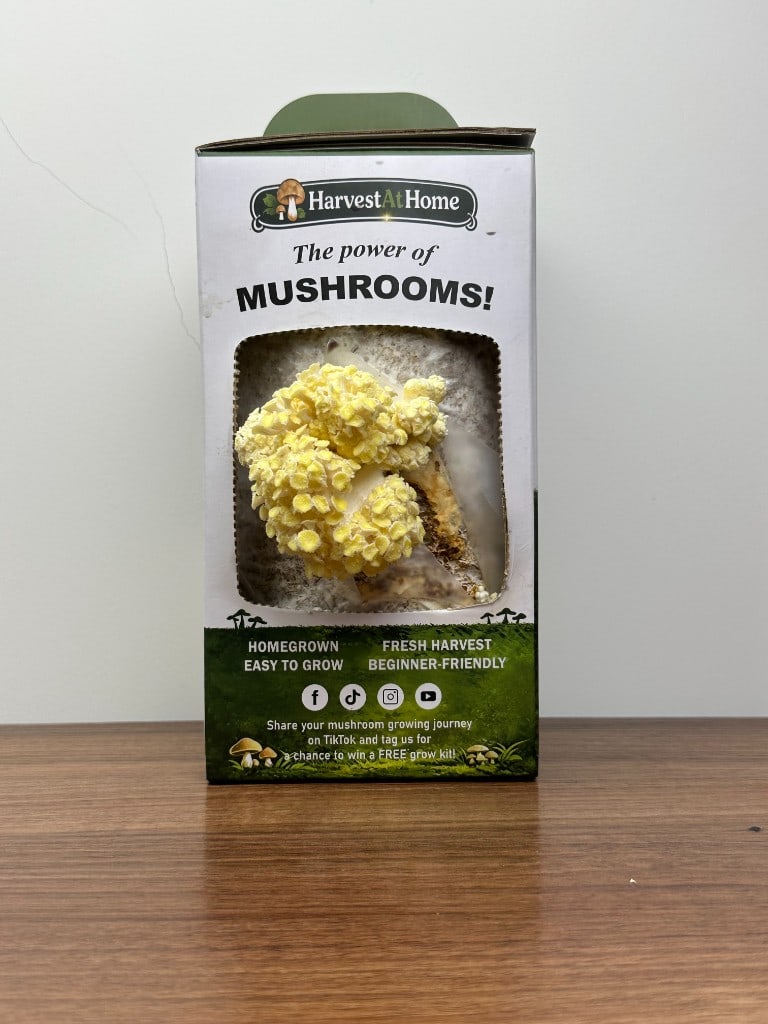
Pink Oyster 'Plant & Grow' Mushroom Block
Outdoor-ready.