On this page
How It Works
Step one: the substrate
Every block starts as a blend of two agricultural by-products: hardwood sawdust from regional mills and wheat straw from grain farms. Neither is food-grade on its own, and both would otherwise go to landfill or animal bedding. We hydrate, blend and pasteurise the mix in sealed steel drums at 68°C for two hours, which kills the bacteria and mould that would otherwise out-compete the fungus.
Step two: inoculation
Pasteurised substrate is still not sterile, and grain spawn is added in a laminar flow hood - a filtered workbench that blows clean air across the bench. One gram of spawn is mixed into each bag. From that point, the fungus does the work: it colonises the substrate over the next three to four weeks, turning the block from brown sawdust into a firm white mass of mycelium.
What colonisation looks like
A properly colonised block is uniform, clean white all the way through, with no green, orange or black patches. When you squeeze it, it should feel solid and springy rather than loose. You should not be able to see individual grains of sawdust - the mycelium has consumed them.
Step three: quarantine
This is the step most home growers never get to do, and it is the reason our blocks are reliable. Every colonised bag goes into a fruiting room for two weeks where temperature, humidity and CO2 are controlled. If a block is going to contaminate, this is when it does it - so we catch it before it reaches you instead of after.
Step four: the fruiting conditions
Now the block goes into a grow room at 60-68°F and 90-95% humidity. Fresh-air exchange is scheduled through the day, because a fruiting room with too little CO2 produces small, dense caps while too much produces long stems. The difference between a good Pink Oyster and a great one is almost entirely in this room.
We photograph every batch at peak flush. If your block does not look like the photographs on this page, something in the chain broke - and we would like to know, because that is how we improve the recipe.
Step five: harvest and packing
Clusters are cut at the base with a clean knife, weighed, and packed the same day they are picked. Nothing is washed, because mushrooms are roughly 90% water and they lose texture fast in a plastic tub. The retail carton is printed, the batch code is stamped, and a Certificate of Analysis for that exact lot goes online before the box leaves the building.
Step six: shipping
Blocks ship Monday to Wednesday in insulated liners. They are not refrigerated - a cold shock damages the fruiting trigger - but they are held below 75°F in transit and shipped with gel packs in the summer and insulated liners in the winter.
When your block arrives, open the outer box, leave the inner bag sealed, and let it come to room temperature for two to three hours before you unwrap it. Opening a cold block straight into a warm, humid room is the most reliable way to get condensation and early contamination.
What that means for you
You are starting at step six. That is a genuine advantage: you skip three weeks of colonisation, a two-week quarantine and every failure mode that comes with them. Your job is to reproduce the fruiting environment for two to three weeks. That is the whole job.
Question one
Answer one.
Complete the grow
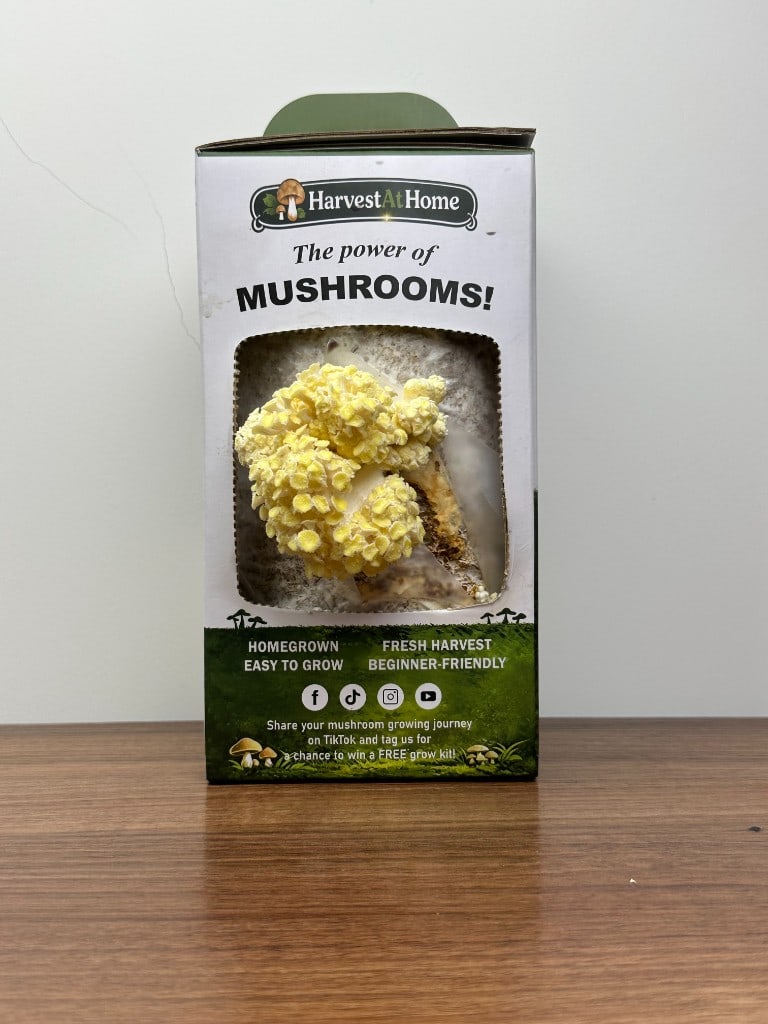
Pink Oyster 'Plant & Grow' Mushroom Block
Outdoor-ready.